Potatoes USA recently hosted a Researcher Roundtable in Denver, convening about two dozen researchers from public breeding programs, universities, and USDA to discuss priorities to bring improved potato varieties to market faster. The event was a first step toward a coordinated, long-term research investment on behalf of the industry.

- The focus question of the discussion: What must a national potato genomics research roadmap prioritize — in capabilities, collaboration, and investment — to accelerate the development of varieties that consumers are enthusiastic about and growers can successfully bring to market?
For growers, the stakes behind the question are practical. The full cycle of developing new varieties can take years, and the traits that matter most on-farm — durable disease and pest resistance, resilience to heat and other stresses, dependable yield, and strong storage and eating quality — usually have to advance together rather than one at a time.
“Research is an investment in a grower’s ability to be profitable down the road,” said Tim Rendall, Director of Production Research at Potatoes USA. “It’s about solving tomorrow’s problems, not just what’s hitting the field today. Right now, moving from identifying a trait to a variety in the ground can take 15 years. If we can get better data earlier in that process and build the systems to make the critical decisions sooner, we can start to shorten that timeline.”
What participants said going in
Ahead of the event, participants completed a survey asking them to set aside their own programs and speak to what the potato research community needs as a whole. Four themes surfaced:
- Genomic tools and infrastructure — faster, more affordable genotyping and phenotyping, better trait markers, and shared, searchable data.
- Stable, sustained funding — with an emphasis on predictability, not just dollars, since short grant cycles rarely match the multi-year timelines breeding actually runs on.
- Coordination across programs — breaking down silos through shared data, germplasm, and connected trial networks.
- A clear, multi-trait breeding target — disease and pest resistance, climate resilience, yield stability, and storage and quality.
Respondents also said no single trait should be pursued at the expense of yield or profitability, and new varieties need a full “stack” of traits rather than one program solving one problem in isolation.
From conversation to consensus on priorities
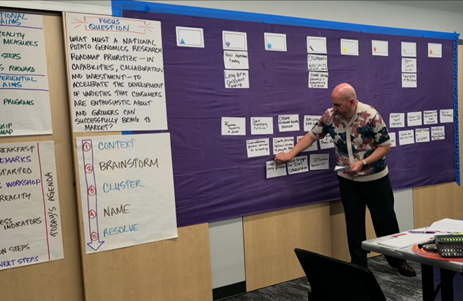
Guided by the facilitation team, participants worked from a long-term, 15-year vision back to concrete one- and three-year steps that could build momentum now.
- Securing sustainable, dependable funding
- Revealing the genomic diversity underlying potato biology
- Building shared platforms for genomics and phenotyping data
- Fostering strategic collaboration across programs
Other priorities included:
- Facilitating germplasm exchange
- Ensuring a strong talent pipeline so expertise carries forward as senior researchers retire
- Developing scalable, cost-effective breeding technologies
- Prioritizing traits around real stakeholder needs with a clear eye toward profitability and quality
What’s next
The roundtable discussion was a starting point. The next step is to synthesize the discussion and the group’s follow-up input into a summary of priorities and current realities. From there, the goal is to narrow the field to a handful of the strongest ideas, align them with the industry’s real needs, and work to put funding behind them.
The longer-term aim is to bring those priorities together into a coordinated, large-scale research investment on behalf of the entire potato industry: one shared vision for developing and commercializing the improved varieties growers will use in the years ahead.
Find more information about Potatoes USA’s Production Research Program.
