Sklarczyk Seed Farm Is Sustainably Growing Clean, Affordable Mini Tubers for the Potato Industry
When Alison Sklarczyk earned her animal sciences degree from Michigan State University, she didn’t intend to go into potato farming.
“I thought I would work in some capacity with livestock,” she said. “When I met my husband Ben, I was very clear I wouldn’t work on the family farm. I was too independent. It’s funny how life and the family farm have ways of roping you back in.”
Sklarczyk Seed Farm isn’t an ordinary potato farm, however. Its tissue culture lab — built to grow clean, disease-free seed potatoes in a sterile environment — was a perfect fit for Alison’s lab experience studying antibiotic resistance in calves.
“Instead of growing E. coli and salmonella, I’m growing tissue plants,” Alison said. “I found a lot of connections between my two backgrounds, and it’s a really good fit.”
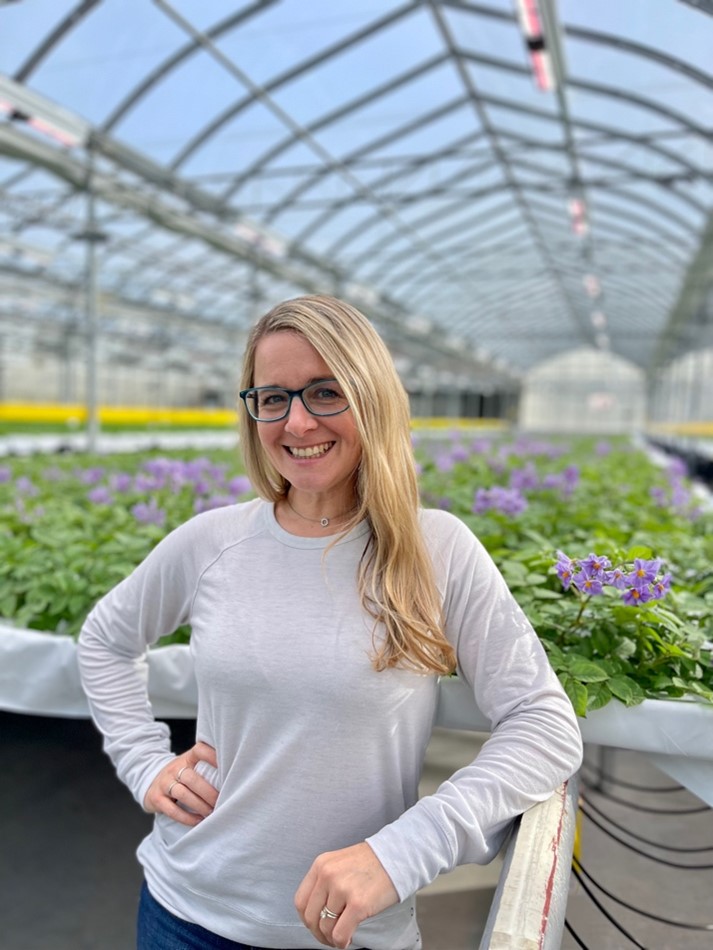
Located on 50,000 square feet of hydroponic greenhouse production space in Johannesburg, Michigan, the farm produces over 10 million seed potatoes each year and ships them throughout the U.S., Canada, Mexico, Chile and the Middle East.
Alison said she and her family once bought a bag of chips on a trip to Chile that turned out to be made from potatoes grown from Sklarczyk Seed Farm seed potatoes.
“It was mind-blowing to be in a different hemisphere on the other end of the world and eating something grown from seed potatoes that came from our farm,” she said. “It’s easy to get lost in our daily work and forget what a big impact it has.”
The farm’s tissue culture lab helps fill contract orders from growers seeking specific varieties of clean, disease-free mini tubers. Alison and her team begin growing plantlets in the tissue culture lab before moving them to greenhouses, which use hydroponic systems instead of soil, which can never be completely sterile.
“It’s still very weather-dependent because we can’t mimic sunlight perfectly,” she said. “We use grow lights on rainy days, and we use technology to help with efficiency. The lights will auto-dim when the sun comes back out. We can provide heat, fertility and everything the plants need other than sunlight.”
Alison said the farm also uses technology to improve energy efficiency and make its operations more sustainable. For example, the lab and greenhouses use geothermal and solar energy; all lighting fixtures are being upgraded for energy efficiency; and the row crop farm keeps up with the latest GPS and sprayer technology, allowing fields to be watered in one sweep without overlapping.
“Anyone involved in agriculture has the same thoughts: If we don’t take care of the land we have, eventually it won’t be here, or it won’t be good quality,” she said. “Anything we can do to improve what we’re doing and how we’re living, we’ll take a stab at it. We live right here on the farm. We’re eating, drinking, and living right here. It doesn’t make sense not to take care of that.”